
Cybersecurity in the Age of AI: New Frontiers, New Threats
- Oct 30, 2025
- 3 min read
October marks Cybersecurity Awareness Month—a timely reminder that in today’s hyperconnected world, ignoring the impact of Artificial Intelligence (AI) on cybersecurity would be a mistake.
AI is transforming industries, economies, and societies. It has repeatedly proven its ability to enhance productivity, accelerate decision-making, and unlock unprecedented innovation. Yet, as AI becomes more powerful, it is also reshaping the cyber threat landscape. Cybersecurity professionals now face a new generation of intelligent, adaptive, and automated attacks—crafted not by humans alone, but by algorithms capable of learning, evolving, and operating at machine speed.
In this article, I share perspectives on how AI is being used both as a force for good and a weapon of disruption, why traditional defenses are no longer sufficient, and what organizations must do to stay ahead in this rapidly evolving battlefield. While AI-powered defenses are becoming more sophisticated, malicious actors are equally leveraging AI to outsmart them.
Artificial Intelligence, in modern cybersecurity, serves as both a defender and an attacker, a double-edged sword.
AI as a Force for Good
When used responsibly, AI can be a powerful friend in cyber defense:
Real-time anomaly detection: Identifies intrusions, fraud, health-related risks as they occur and identifying outliers in data as it is being generated from devices & systems
Automation of security monitoring: Streamlines incident response and threat remediation.
Enhanced threat intelligence: Processes vast amounts of data to predict and prevent attacks before they happen.
AI as a Threat
However, the same capabilities that make AI transformative also make it dangerous in the wrong hands:
Generative AI can create realistic phishing content, deepfakes, and misinformation at scale.
Automated vulnerability discovery enables attackers to find and exploit weaknesses faster than organizations can patch them.
Autonomous cyberattacks can now be launched in minutes, targeting thousands of systems simultaneously.
Top AI-Driven Cyber Threats to Watch
Top AI-Driven Cyber Threats to Watch

AI-Powered Phishing & Deepfakes
Cybercriminals now use AI to execute highly convincing social engineering attacks. Gone are the days of poorly written phishing emails—today’s AI-generated messages mimic tone, style, and even voice or video of trusted individuals. Fraudulent executive calls, fake invoices, or realistic “urgent requests” are becoming indistinguishable from reality.
Automated Vulnerability Discovery
AI-driven tools can scan codebases, networks, and applications within seconds, identifying exploitable weaknesses at a scale no human team could match. Alarmingly, some AI systems can automatically exploit vulnerabilities before patches are deployed.
AI-Generated Malware & Self-Evolving Code
Malware is evolving into a new class of intelligent threats. AI can generate polymorphic code that rewrites itself, changes patterns, and evades traditional antivirus signatures. These adaptive attacks learn how to bypass firewalls, endpoint detection, and behavioral analytics systems.
Data Poisoning & Model Manipulation
As AI models become integral to business operations, attackers are shifting focus toward corrupting the data that feeds them. By injecting malicious or biased data, adversaries can manipulate AI outcomes—or even extract proprietary information from trained models.
Malicious AI Bots & Autonomous Attacks
Next-generation bots can mimic human behavior, even bypass CAPTCHA, and conducting Distributed Denial of Service (DDoS) attacks with unprecedented efficiency. These autonomous systems can alter tactics, change identities, and continuously adapt in real time.
Becoming AI-Ready: Proactive Steps for Cyber Defense
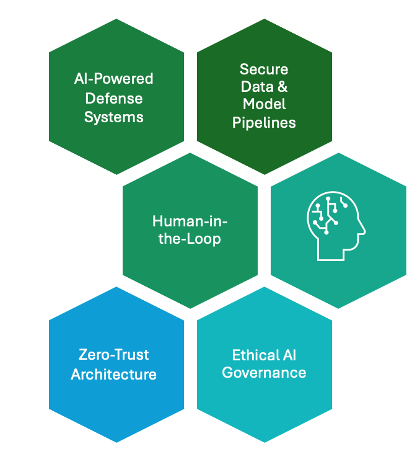
AI-Driven Cyber Defense Systems
Use AI for predictive threat hunting, behavior analytics, and automated incident response.
Adopt a Zero-Trust Architecture
Trust no one, verify everything. Continuously authenticate and authorize users, devices, APIs, and data transactions—both internal and external.
Keep Humans in the Loop
AI can detect patterns, but humans must interpret intent. Invest in workforce training for AI-assisted investigations, digital forensics, and ethical oversight.
Secure Data Fabric and AI Models
Protect your data pipelines, training datasets, and model repositories. Establish mechanisms to detect data poisoning and model breaches.
Implement Ethical AI Governance
Create clear policies for AI use within your organization. Monitor not only for external attacks, but also for improper or unethical internal deployment of AI systems.
The Future of Cyber Protection: Safeguarding Trust
As AI continues to evolve, the focus of cybersecurity is shifting—from protecting systems to protecting trust. The greatest risk ahead isn’t just data loss or fraud; it’s the erosion of truth, identity, and confidence in our digital world.
Technology and security leaders must adapt, combining human intuition with machine intelligence to create resilient, adaptive defenses. Only then can we build a digital fortress capable of withstanding the intelligent adversaries of the AI era.
Comments